
Showing posts with label social media marketing. Show all posts
Showing posts with label social media marketing. Show all posts
Friday, November 23, 2018

Tuesday, October 30, 2018
Social Media Monitoring Part Two: Recommendations for Target
Recap From Last Week
Last week we covered Target's social media marketing of their Fall Style Campaign, announced September 11, 2018. We looked at Target's profiles and activity on Twitter and Instagram, their announcement and use of the #TargetMyWay label on each platform, and examined the Social Mention and Google Trends data to determine that their Social Media Marketing strategy for the campaign was mostly a bust. This week, we will look at some of the specific ways that Target's strategy missed the mark and how they can improve their use of social media going forward.
This Week's Analytics
Google Trends
Overall, the interest in Target over the past seven days is consistent with the trends we looked at last week. There was increased interest in Target on October 28, which I credit to an Instagram post from LL Cool J, discussed in more detail below.
 |
| 7-day trends for Target Corporation captured 10/29/18 |
Social Mention
The TargetMyWay label is back from the dead in honor of Halloween this week! The strength, passion, and reach have all increased from the data we examined last week. In addition, the sentiment is overwhelmingly positive. As discussed last week, I credit the spark in #TargetMyWay use to the influencers and celebs who are helping to share the hashtag in the groundswell. This week, it was LL Cool J who resurrected the hashtag by partnering with Target to surprise customers with free Target gift cards. Consistent with the trends we looked at last week, LL Cool J initially used the hashtag on his Instagram and it was later shared on Twitter by others.
 |
| Target store, captured 10/29/18 |
 |
| #TargetMyWay, Captured 10/29/18 |

Goals and Recommendations
Goal: Increase interest in Target to reduce the threat of competitors.
Amazon and Walmart are two of Target's biggest threats as a company. Unfortunately for Target, both Amazon and Walmart generate more interest in the social media world, as shown in the Google Trends comparison chart below.
 |
| 7-day trends for Target, Walmart, and Amazon, captured 10/27/18 |
Remember from last week that Minnesota was the only state in which interest in Target outranked interest in Walmart? Well once Amazon in thrown into the mix, Target's grip on Minnesota disappears.
 |
| 7-day trends by location for Target, Walmart, and Amazon, captured 10/27/18 |
Recommendation 1: Invest in additional social media monitoring and listen to what the groundswell wants from Target
Some important questions have come up through my social media monitoring project. First, is Target doing anything different from a social media marketing perspective in Minnesota that contributes to their popularity there? Second, if they are doing anything different, how can their strategy in Minnesota be harnessed to generate greater interest nationwide? Third, how does the groundswell want to interact with Target? What kind of relationship are they interested in building with the Target brand? Finally, where on the Social Technographics Ladder to Target customers fall? What strategy will work for the Social Technographic Profile of Target Customers?
I believe that many of these questions can be answered through additional social media monitoring, targeted at analyzing what is being done in Minnesota and other states with the highest interest in Target. In addition, Target should place a greater emphasis on listening within the groundswell. I found Target's ability to listen both successful and unsuccessful through this project. Target deserves credit for acknowledging the value in adopting and marketing the groundswell-created "Tarzhay" nickname. However, they should have placed a greater emphasis on listening to what labels the groundswell was using to discuss their brand instead of trying to force a label they created.

Target should work to interact with the groundswell in a more natural, and less aggressive way. They were much more successful at this on Instagram where the hashtag was picked up by influencers and celebs, but definitely, have room to improve on Twitter. One way that Target can try to do this is by incentivizing the use of the label. For example, Target can choose to feature their favorite #TargetMyWay posts on their social media profiles. Depending on what Target is willing to spend, they could also offer rewards, such as Target gift cards, for posts that were selected to be featured.
I believe that many of these questions can be answered through additional social media monitoring, targeted at analyzing what is being done in Minnesota and other states with the highest interest in Target. In addition, Target should place a greater emphasis on listening within the groundswell. I found Target's ability to listen both successful and unsuccessful through this project. Target deserves credit for acknowledging the value in adopting and marketing the groundswell-created "Tarzhay" nickname. However, they should have placed a greater emphasis on listening to what labels the groundswell was using to discuss their brand instead of trying to force a label they created.
Recommendation 2: When it comes time to talk with and energize the groundswell, do it naturally
As we covered last week, Target's forceful use of the TargetMyWay label was an unnatural way to interact with the groundswell. Unfortunately, the hashtag suffered as a result.
Target should work to interact with the groundswell in a more natural, and less aggressive way. They were much more successful at this on Instagram where the hashtag was picked up by influencers and celebs, but definitely, have room to improve on Twitter. One way that Target can try to do this is by incentivizing the use of the label. For example, Target can choose to feature their favorite #TargetMyWay posts on their social media profiles. Depending on what Target is willing to spend, they could also offer rewards, such as Target gift cards, for posts that were selected to be featured.
Recommendation 3: Maximize their pop-culture status and energize their brand enthusiasts
There is no arguing with the fact that Target has achieved some type of "pop-culture status". From their presence in internet memes to Buzzfeed quizzes and articles, they have a niche of loyal brand enthusiasts.
 |
| Article from Buzzfeed |
 |
| Quiz from Buzzfeed |
Final Thoughts
Going forward, Target should create a strategy guided by the ultimate goal of increasing interest in their brand in order to mitigate the threat of their largest competitors, Walmart and Amazon.
My recommendations for Target in working towards this goal are:
My recommendations for Target in working towards this goal are:
- Invest in additional social media monitoring and gain a better understanding of what the groundswell wants from Target
- Engage with the groundswell in a more natural and less forced way. In the future, especially avoid trying to force anything on the groundswell.
- Take advantage of the pop-culture status of the brand and energize Target enthusiasts through communities or forums.
And yes, I did take that Buzzfeed quiz...

Monday, October 22, 2018
Social Media Monitoring Part One: Target Corporation
Introduction
The accent mark above the Target bulls-eye logo references Target enthusiasts tendency to refer to the company with a faux French accent by pronouncing the store "Tarzhay". In addition to adopting the Tarzhay nickname, Target introduced a campaign hashtag, #TargetMyWay, in the commercial below, featuring Todrick Hall.
Platforms
Target is active across many mainstream social media platforms including Twitter, Instagram, Facebook, and YouTube. A huge component of this campaign is Target's emphasis on the #TargetMyWay hashtag and encouraging the groundswell to share their photos and videos of how they Target their way! Unfortunately, after a few weeks of trying to make #TargetMyWay happen, the buzz mostly fizzled out. Let's take a closer look at a few of the main platforms Target used to try and promote the campaign and how the groundswell was participating.
Target's Twitter profile has 1.93 million followers as of October 18, 2018. Some Twitter users have adopted #TargetMyWay and use it to tag their tweets.


However, much of the use of #TargetMyWay was actually from Target themselves. As shown in the tweets below, Target would reply to posts which referenced their brand using the hashtag #TargetMyWay.


I assume that Target's intent in replying with the hashtag was to encourage other users to start using it themselves. However, this strategy was largely unsuccessful as few users picked up the label to use themselves. It seems that eventually, Target gave up on trying to get others to use the hashtag and stopped replying with it all together. Every few days a Twitter user will use #TargetMyWay, but overall the label failed to be picked up by users. Overall, Target's attempt to encourage Twitter users to adopt the #TargetMyWay hashtag was unsuccessful.

Target operates two separate profiles on Instagram, the main Target profile and the Target Style profile. Target's Instagram profile has 3.2 million followers while the Target Style profile has 2 million followers as of October 18, 2018. The descriptions of both profiles encourage users to tag them and use the #TargetMyWay label on photos.


As of October 18, 2018, there were 2,706 Instagram posts that users had tagged #TargetMyWay, and users were continuing to tag posts every day. While 2,706 is a far cry from the 4.6 million Instagram posts tagged #Target, it is quite an improvement from the fizzle-out of #TargetMyWay on Twitter.


As of October 18, 2018, there were 2,706 Instagram posts that users had tagged #TargetMyWay, and users were continuing to tag posts every day. While 2,706 is a far cry from the 4.6 million Instagram posts tagged #Target, it is quite an improvement from the fizzle-out of #TargetMyWay on Twitter.

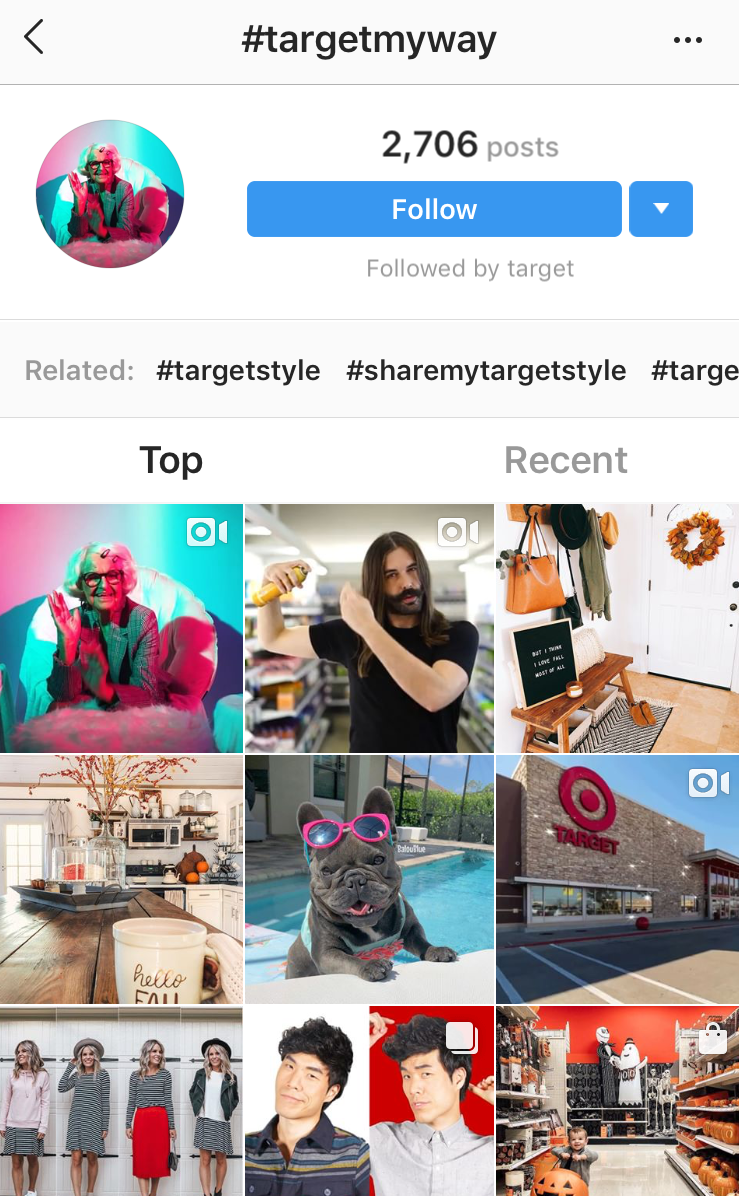

In addition, the hashtag got much more attention from influencers and celebrities on Instagram than it got on Twitter. A few of the more well-known people who used the hashtag are Baddie Winkle (3.8 million followers), Eugene Lee Yang (1.5 million followers), Jonathan Van Ness (2.7 million followers), and Mindy Kaling (3.5 million followers). It is possible that since the label was picked up by famous Instagram-ers, the groundswell was more likely to see it in use and use it to label their own photos and videos. Here is one example of an influencer, Baddie Winkle, using the hashtag on Instagram.
Analytics
Google Trends
First, let's take a look at the 90-day-trends of Target through Google Trends. As you can see from the graph below, Target's Fall Style campaign, announced on September 11, 2018, did not actually increase the interest in Target. In fact, interest in Target dropped slightly between September 10, 2018, and September 13, 2018, until interest increased again on September 14, 2018, consistent with the overall trend of the 90-day graph. According to this graph, the announcement of the Fall Style Campaign, the hashtag, and the nickname did not create a large impact in the groundswell.
The two graphs below compare the interest in Target with a competitor, Walmart, over 12-months and 5-years.
 |
| 90-Day-Trend of Target, taken 10/22/18 |
 |
| 12-month-trend of Target v. Walmart, taken 10/17/18 |
 |
| 5-year-trend of Target v. Walmart, taken 10/17/18 |
As shown in these graphs, Target has never once had a greater interest than Walmart over a five year period. In addition, the chart below shows that the only state in the U.S. where the searches for Target beat out the searches for Walmart is in Minnesota.
 |
| Interest in Target v. Walmart by State, taken 10/17/18 |
Social Mention
Below are four Social Mention snapshots of the TargetMyWay hashtag. As you can see from these snapshots, #TargetMyWay did not start with much strength but had a higher passion and reach score. A higher passion score means it is likely that users will repeatedly use the hashtag while a higher reach means Target had a large range of influence. In addition, all mentions of #TargetMyWay were either positive or neutral. This is a good sign because it shows that the groundswell did not commander the hashtag to talk negatively about Target's brand.
 |
| #TargetMyWay, taken 10/1/18 |
 |
| #TargetMyWay, taken 9/27/18 |
 |
| #TargetMyWay, taken 10/17/18 |
 |
| #TargetMyWay, taken 10/11/18 |
However, by October 11, 2018, one month after the fall style campaign was announced, the use of the hashtag had declined. The hashtag has not recovered from the drastic decrease in interest and Social Mention charts have looked almost identical to the 10/17/18 chart since then.
In comparison, the Social Mention charts below show the number of mentions for Target and "Tarzhay", the nickname they adopted through the campaign.
 |
| Target, taken 10/17/18 |
 |
| Tarzhay, taken 10/17/18 |
Final Thoughts
Target tried to energize the groundswell by interacting with them on Twitter and tagging other Twitter user's tweets with the #TargetMyWay label. However, this strategy was unsuccessful on Twitter where the hashtag was not picked up by most users. Target should have identified their audience, where they fall on the Social Technographics Ladder, and their goals for the Fall Style campaign to create a more comprehensive and effective social media marketing strategy for the campaign. Next week I will go more into detail regarding what Target should have done differently with this campaign and how they can develop stronger social media strategies for future style campaigns.
Thank you for reading!
Monday, October 15, 2018
"We Sincerely Apologize"
Over the last several weeks we have examined companies and campaigns that use social media to listen to, talk with, and energize the groundswell. Most of the companies we have looked at so far are using social media pretty successfully. Today, we are going to look at Spectrum, a TV, internet, and phone provider which has been much less successful in their use of social media than other organizations we have looked at. The video below is a typical experience that many Spectrum customers have blogged or written about online.
"We sincerely apologize" and "I am so sorry for the service issue" are two variations of the typical internet response from company representatives that we see on social media. Has receiving a half-hearted, and probably insincere, apology from a company representative ever fixed a problem you were having? Me neither! Unfortunately, this is a typical response that Spectrum sends its customers when they complain about problems with their Spectrum service. Spectrum uses Facebook, Twitter, Instagram, and Youtube. And unfortunately for Spectrum, customers are angry across every platform.


In an attempt to corral the negative comments and complaints Spectrum introduced the Twitter profile Ask Spectrum where customers can tweet their problem and receive help from the Spectrum customer support team. However, the response from a customer service representative is typically a "copy and paste", generic-looking response asking the customer to direct message their account information to receive assistance. For example, the response below was sent to several different customers who tweeted that they needed assistance with different problems.

It is possible that the customers who tweeted their problem on Twitter had their problem solved in the privacy of their Twitter direct messages. However, seeing as the rating of Spectrum services earns only 1.3 out of 5.0 stars on Facebook, I think it is safe to say that Spectrum customers are not satisfied with the service or support they are receiving, at least not in Worcester.

We know from Groundswell that one way listening to the groundswell changes your organization is through the "no-more-being-stupid factor" (97). As we are seeing here, Spectrum customers are ruthlessly exposing Spectrum's stupid, unfair, or useless policies, procedures, and products. Li and Bernoff state that companies must listen to the complaints from the groundswell and stop being stupid! However, many cable companies, including Spectrum, can get away with continuing to be stupid because they hold a monopoly in many areas. Therefore, no matter how much their customers complain, there is likely little competition in the area, and few, if no other providers for the customers to turn to.

Poor customer service, half-hearted online apologies, and the continuation of stupid practices despite anger from the groundswell are just a few reasons why Spectrum has built an online community of anti-Spectrum enthusiasts. Spectrum may be able to salvage their online presence if they recognize the importance of having the groundswell on their side and commit to strengthening their customer service practices. However, until they realize the importance of having positive buzz, the groundswell will continue to mercilessly expose Spectrum's stupidity.

"We sincerely apologize" and "I am so sorry for the service issue" are two variations of the typical internet response from company representatives that we see on social media. Has receiving a half-hearted, and probably insincere, apology from a company representative ever fixed a problem you were having? Me neither! Unfortunately, this is a typical response that Spectrum sends its customers when they complain about problems with their Spectrum service. Spectrum uses Facebook, Twitter, Instagram, and Youtube. And unfortunately for Spectrum, customers are angry across every platform.


In an attempt to corral the negative comments and complaints Spectrum introduced the Twitter profile Ask Spectrum where customers can tweet their problem and receive help from the Spectrum customer support team. However, the response from a customer service representative is typically a "copy and paste", generic-looking response asking the customer to direct message their account information to receive assistance. For example, the response below was sent to several different customers who tweeted that they needed assistance with different problems.

It is possible that the customers who tweeted their problem on Twitter had their problem solved in the privacy of their Twitter direct messages. However, seeing as the rating of Spectrum services earns only 1.3 out of 5.0 stars on Facebook, I think it is safe to say that Spectrum customers are not satisfied with the service or support they are receiving, at least not in Worcester.

We know from Groundswell that one way listening to the groundswell changes your organization is through the "no-more-being-stupid factor" (97). As we are seeing here, Spectrum customers are ruthlessly exposing Spectrum's stupid, unfair, or useless policies, procedures, and products. Li and Bernoff state that companies must listen to the complaints from the groundswell and stop being stupid! However, many cable companies, including Spectrum, can get away with continuing to be stupid because they hold a monopoly in many areas. Therefore, no matter how much their customers complain, there is likely little competition in the area, and few, if no other providers for the customers to turn to.

Poor customer service, half-hearted online apologies, and the continuation of stupid practices despite anger from the groundswell are just a few reasons why Spectrum has built an online community of anti-Spectrum enthusiasts. Spectrum may be able to salvage their online presence if they recognize the importance of having the groundswell on their side and commit to strengthening their customer service practices. However, until they realize the importance of having positive buzz, the groundswell will continue to mercilessly expose Spectrum's stupidity.

Monday, October 8, 2018
Reflection Two
In chapters 5 through 8 of Groundswell by Charlene Li and Josh Bernoff, we learn the importance of talking with, listening to, and energizing the groundswell. Li and Bernoff also provide us with helpful advice on how to successfully use a variety of tactics to tap into the groundswell to market our brands. These chapters include a lot of very helpful advice, but I am going to focus on 3 main points from this chapter that I think are the most important in marketing our brands today.
First, we need to make an effort to listen to and energize the groundswell. Li and Bernoff state that one way we can listen to the groundswell by setting up a private community. As mentioned in my post last week, Zox is one company which set up private communities for their customers. Harley Davidson is a second brand that has created a community specifically for customers, the Harley Owners Group. Membership is reserved for Harley owners and riders and includes many benefits including access to the members-only website, H.O.G. merchandise, and admittance to exclusive rallies and events, to name a few. These private communities are a place for us to listen to our customers in a 'mini-groundswell' while connecting with and energizing our most loyal customers.
Second, Li and Bernoff explain the value in energizing the groundswell by encouraging our promoters to market our brand through word of mouth. In the digital age, trust comes from the ground level, so word of mouth is very important in marketing our brands. One way to build connections with our promoters is through ratings and reviews. Including a ratings and reviews system has many benefits from increasing purchases to providing feedback to your company on their products and services. According to Li and Bernoff, 96% of customers use online reviews to help make purchases (p. 138) while 62% of online North American consumers trust ratings and reviews (p. 132).

Amazon is one company which utilizes ratings and reviews for their products. Not only can customers view the total star-rating for a product, but they can also view star-ratings by feature or ratings from certain customer groups. For example, take a look at the rating breakdown for a JanSport Right Pack Laptop Backpack.


First, we need to make an effort to listen to and energize the groundswell. Li and Bernoff state that one way we can listen to the groundswell by setting up a private community. As mentioned in my post last week, Zox is one company which set up private communities for their customers. Harley Davidson is a second brand that has created a community specifically for customers, the Harley Owners Group. Membership is reserved for Harley owners and riders and includes many benefits including access to the members-only website, H.O.G. merchandise, and admittance to exclusive rallies and events, to name a few. These private communities are a place for us to listen to our customers in a 'mini-groundswell' while connecting with and energizing our most loyal customers.
Second, Li and Bernoff explain the value in energizing the groundswell by encouraging our promoters to market our brand through word of mouth. In the digital age, trust comes from the ground level, so word of mouth is very important in marketing our brands. One way to build connections with our promoters is through ratings and reviews. Including a ratings and reviews system has many benefits from increasing purchases to providing feedback to your company on their products and services. According to Li and Bernoff, 96% of customers use online reviews to help make purchases (p. 138) while 62% of online North American consumers trust ratings and reviews (p. 132).

Amazon is one company which utilizes ratings and reviews for their products. Not only can customers view the total star-rating for a product, but they can also view star-ratings by feature or ratings from certain customer groups. For example, take a look at the rating breakdown for a JanSport Right Pack Laptop Backpack.

In addition to Amazon's rating feature, they have introduced the ability for customers to ask and answer questions regarding the product. This feature takes the ratings and review feature one step further and allows customers to directly ask questions they have prior to purchasing the product in question.

Finally, implementing support forums is one tactic to help the groundswell support itself. According to Li and Bernoff, an average customer support call costs an organization 6 to 7 dollars while a technical support call costs between 10 to 20 dollars. In addition, customer support lines can be incredibly frustrating for customers. Community support forums are one option we can consider to reduce the volume of support calls while still ensuring customer's questions are answered. PlayStation is one company that has implemented community support forums for their products.


I personally use the support forums anytime I have a technical issue. As a result, I personally have never had to pick up a phone and actually call for technical support. The ability to ask questions on the community support forum saves PlayStation money on support calls and saves customers the frustration of having to deal with customer support lines.
Do you know of any other brands who have used one of these strategies? Were they successful? Share your thoughts below!
Monday, October 1, 2018
Zox Communities
If you were asked to identify the single most important aspect when trying to tap into the groundswell, what would you say? Personally, I would argue relationships! Relationships are a key component in energizing the groundswell about our products and services. According to Li and Bernoff there are three techniques to build relationships and energize our customers using the groundswell:
1. Utilize ratings and reviews
2. Create a community
3. Energizing existing communities.
The company we are going to look at today, Zox, created online communities related to their brand to energize their customers.
1. Utilize ratings and reviews
2. Create a community
3. Energizing existing communities.
The company we are going to look at today, Zox, created online communities related to their brand to energize their customers.
Zox is an accessory company started by the Kuipers brothers several years ago. Zox makes limited-edition wristbands, clothing, and backpacks. If there is anything the "bros" do better than producing one-of-a-kind accessories, it is marketing their brand on social media and creating communities to energize their customers. Zox markets their products across a variety of platforms including Facebook, Twitter, and Instagram. However, we know that simply posting to these platforms is not enough. Brands must use these platforms to build relationships with their customers and engage the groundswell.
 |
| Brandon, Jason, and Jordan Kuipers- Creators of Zox |

The Zox VIP community is a closed group on Facebook with over 7,300 members. Zox VIP is a place where "Zoxers" can share their love of the products and connect with each other and the Kuipers. Zox energizes the VIP customers by sharing information not yet available to non-VIP customers, hosting special giveaways and swaps, soliciting ideas for new products, and running a live stream where Zoxers can participate in a real-time Q+A and discussion.

Energizing our customers has huge benefits for our brand. For Zox, energizing their customers through the VIP community helps build relationships between themselves as owners and their customers, increases customer excitement and loyalty, creates brand enthusiasts who will market Zox through word-of-mouth, and increases their return on investment. However, we also know that the benefits of building communities within the groundswell cannot come without some risk! Once the groundswell begins to talk about your brand, what they say is out of your control. On the VIP page, Zox has encountered some of the risks that come with building an online community, including a large number of complaints or negative posts regarding their brand and products. In addition, there has been an overwhelming growth of the community, leaving the brothers struggling to keep up with the increased demands.

Cultivating our communities is the same as cultivating any other relationship, it requires time, patience, and constant adjustment to continue its good health and growth. Zox is finding themselves in a place where their customer base has expanded and their online communities have followed close behind. In turn, they must adjust their approach and consider expanding their marketing and brand monitoring. To maintain a strong and positive online presence and community, we must always be adjusting our strategies, continuing to listen to the groundswell, and embracing our brand enthusiasts.
What do you think? Has Zox used online communities effectively? How can they make adjustments to ensure their communities continue to grow in a positive way?
Monday, September 24, 2018
Reflection One
The past few weeks, we have delved into the first four chapters of Groundswell, by Charlene Li and Josh Bernoff. Li and Bernoff define the groundswell as, "a social trend in which people use technologies to get the things they need from each other, rather than from traditional institutions like corporations". There is a lot of valuable content from these chapters that is useful to us when developing a more effective social media marketing strategy to advance our goals.
 First, Li and Bernoff explain the importance of identifying your target population and using a Social Technographic Profile to determine how they participate in the groundswell. The Social Technographic Profile provides us with data regarding how people use technology. We can use this data to categorize consumers as Creators, Conversationalists, Critics, Collectors, Joiners, Spectators, or Inactives.


The overwhelmingly negative response killed any chances the campaign had of success. As we work to promote our own brands we must remember that our brand is what the groundswell says it is, and we need to anticipate what they might say! We also must always be monitoring how consumers are talking about our brands. Don't be like Dove. Identify your target audience, design a strategy to cultivate relationships with them, and always think through the possible consequences of a campaign.
First, Li and Bernoff explain the importance of identifying your target population and using a Social Technographic Profile to determine how they participate in the groundswell. The Social Technographic Profile provides us with data regarding how people use technology. We can use this data to categorize consumers as Creators, Conversationalists, Critics, Collectors, Joiners, Spectators, or Inactives.
Once you identify your target audience and determine their classification based on their Social Technographic Profile, you can determine your strategy based on how your audience participates in the groundswell. Consider my post last week on the marketing value of using photo modes in video games. Pew Research Center states that 72% of men aged 18-29 play video games compared to 49% of women in the same age range. In addition, the Social Technographic Profile of young men and women in Groundswell shows that young men are likely to be Creators, Critics, Joiners, and Spectators. Therefore, a gaming feature in which gamers can create user-generated content, share their creations, and interact with others is an ideal way to engage gamers.
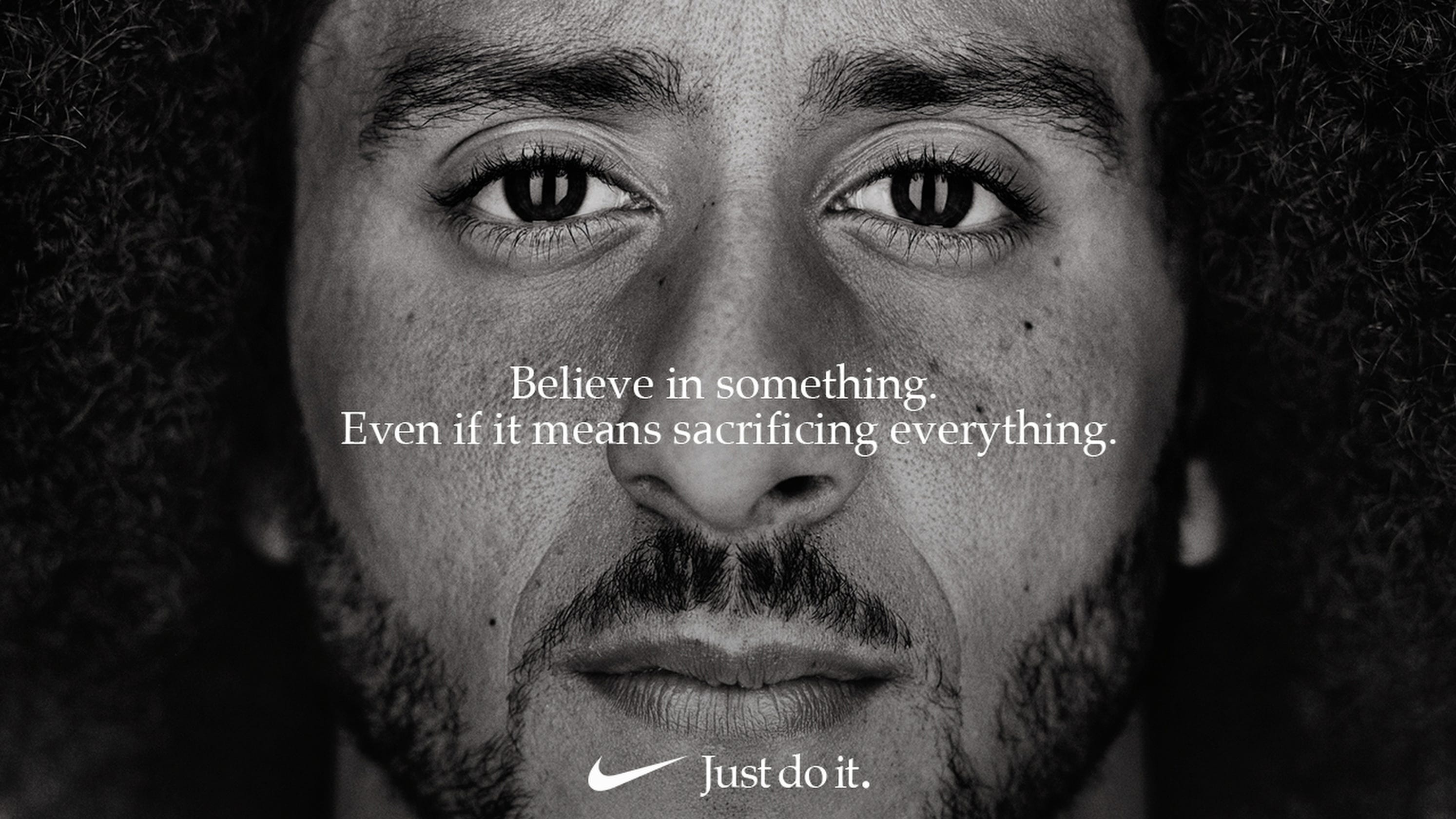
Second, for us to effectively engage the groundswell, Li and Bernoff state we must focus on building relationships with our consumers instead of striving for technical competency across platforms. The most current (and controversial) example that we are all familiar with is the Nike's Just Do It campaign advertisement featuring Colin Kaepernick. Take a look at "Dream Crazy", the first TV advertisement in the campaign below:
According to Sprout Social, 66% of customers are belief-driven buyers and believe it is important for brands to take a stand on social and political issues. In addition, 78% of liberal identifying customers are belief-driven buyers compared to only 52% of conservative identifying customers. Since Nike's primary customer base tends to be urban and liberal young people, the best strategy for Nike to build relationships with customers is to take a stand on an issue that their customer base will likely be sympathetic toward.
According to sales information available so far, their controversial strategy has been a success. Around the time the ad released, Nike gained 170,000 new followers on Instagram and comments about Nike increased 1,678%. While commenting on Nike increased immensely, it is imperative to remember that not all the comments are positive. Online sales increased 31% and Nike stock hit a record high of $83.90 following the release of the ad, indicating they were successful in targeting their audience and building a relationship with them.
Finally, it is critical that we remember that our brand is what the groundswell says it is. Through reviews, tags, Wikipedia contributions, and other activities, the groundswell is who defines our brand. If the groundswell has positive things to say about your brand, things like reviews or tags can boost sales or help additional consumers find your content. If they do not have positive things to say about your brand, these groundswell activities can sour a brand or campaign. For example, in 2017 Dove launched a new line of 7 body-shaped shampoo bottles, "to show our iconic bottle can come in all shapes and sizes too". However, instead of inspiring customers, the bottles were ridiculed by the groundswell on several platforms, including Twitter.

The overwhelmingly negative response killed any chances the campaign had of success. As we work to promote our own brands we must remember that our brand is what the groundswell says it is, and we need to anticipate what they might say! We also must always be monitoring how consumers are talking about our brands. Don't be like Dove. Identify your target audience, design a strategy to cultivate relationships with them, and always think through the possible consequences of a campaign.
Subscribe to:
Posts (Atom)